- PROCESS PLANT OPERATORS
- INDUSTRIAL MAINTENANCE
- COMMUNITY COLLEGES
TRAINING COURSE on POSITIVE DISPLACEMENT PUMPS - CBT / WBT
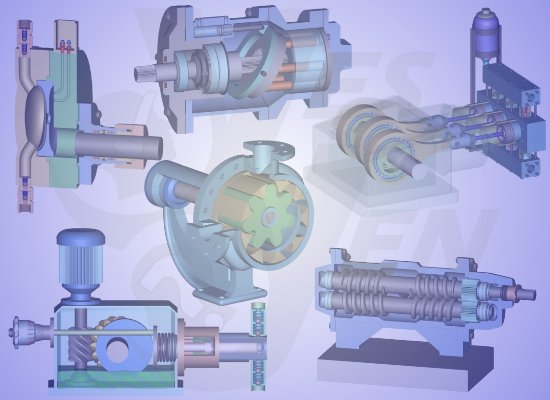
The Positive Displacement Pump Training Course has been developed to assist in Pump Maintenance and Operation. It covers both Reciprocating Pump Working as well as Rotary Pump Working Principles. Explicit Graphics and Animation give an in-depth understanding on working details of various pump types like Screw Pump Working and Gear Pump Working. The training course, designed with extensive Graphics and Animation, gives a virtual Detailed Practical exposure on a large number of Positive Displacement Pumps Types like Gear, Lobe, Vane, Screw, Peristaltic, Metering, Power, Diaphragm, Piston, Beam, Hydraulic, etc. with a detailed Pump Classification. The course also includes an Interactive, Graphically supported Troubleshooting Guide.

Click above 'image' for Animated Demo/Guided Tour of the Positive Displacement Pumps
(Reciprocating & Rotary Pump Training) Training Course which focuses on Graphics, Animation and Step-by-Step Learning
POSITIVE DISPLACEMENT PUMP - A FEW HIGLIGHTS

- An extensive range of Pumps covered and classified
- Pumps also categorized and described based on their Industrial Service
- Extensive 2D / 3D Graphics, Models and Animations
- An Interactive, Graphically supported Troubleshooting Guide
- Skill tests, Certificate printouts.
The Positive Displacement Pump Training Course (Reciprocating Pump Training and Rotary Pump Training) covers both the Rotary Pump Working and Reciprocating Pump Working. The Training course covers a large range of Pump types like Screw, Gear, Lobe, Vane, Peristaltic, Metering, Power, Diaphragm, Axial Piston Pump, Swash Plate, Wobble Plate Piston, Bent Axis, Radial Piston Pump, Variable Displacement, Sucker Rod, Hydraulic, Beam, etc.
The primary focus on Pump Graphic / Positive Displacement Pump Animation (Reciprocating Pump Animation and Rotary Pump Animation) in the CBT helps in very clearly understanding the Pump Working Principle. The Working principles of various pumps like Screw Pump Working and Working of Gear Pumps are easily understood by the intricate Pump Animations.
The Positive Displacement Pump Training Program has a dedicated module to assist Rotary and Reciprocating Pump Troubleshooting. Animated Cut-Sections clearly explains Rotary and Reciprocating Pump Working and gives a Deep Insight into Pump Operation and how Pumps Work.
The POSITIVE DISPLACEMENT PUMP TRAINING course provides a
Intricate, Practical (virtual), Comprehensive Knowledge on the Subject!
OPTIONS for INDUSTRIES / VOCATIONAL TRAINING INSTITUTES / COMMUNITY COLLEGES
Standalone optionUS$349
- For access in multiple systems (one at a time).
Multiple user option10 user - US$1050 50 user - US$1750Unlimited user - US$2100
- For simultaneous access in an organization LMS.
Multiple user option (SCORM)Customized rates based on requirement
- For simultaneous access in SCORM compliant organization LMS.
Online CLOUD hosting by Yes Yen Customized rates based on requirement-
- Features include CUSTOMIZED webpages for user access with the NAME and LOGO of the organization and individual user performance data.
CONTACT US for further details.
*note: Customized logo embedding provided in the above options.
TRAINING COURSE CONTENT
- 1. Introduction
- 1.1. Principle of Operation
- 1.2. Classification
- 1.2.1. Rotary Pumps - Various types
- 1.2.2. Reciprocating Pumps - Various types
- 2. Common process industry pumps
- 2.1. Rotary Pumps
- 2.1.1. Gear Pumps
- 2.1.1.1. External Gear Pumps
- 2.1.1.2. Internal Gear Pumps
- 2.1.2. Lobe Pumps
- 2.1.2.1. External Lobe Pumps
- 2.1.2.2. Internal Lobe Pumps
- 2.1.3. Vane Pumps
- 2.1.3.1. Sliding Vane Pumps
- 2.1.3.2. Flexible Vane Pumps
- 2.1.4. Screw Pumps
- 2.1.4.1. Single Screw Pumps (Progressing Cavity Pumps)
- 2.1.4.2. Multiple Screw Pumps
- 2.1.5. Peristaltic Pumps
- 2.2. Reciprocating Pumps
- 2.2.1. Metering Pumps
- 2.2.1.1. Plunger Pumps
- 2.2.1.2. Diaphragm Pumps
- 2.2.2. Power Pumps
- 2.2.2.1. Plunger / Piston Pumps
- 2.2.2.2. Diaphragm Pumps
- 3. Common oil field pumps
- 3.1. Beam Pumps (Sucker Rod Pumps)
- 3.2. Hydraulic Pumps
- 4. Common hydraulic service pumps
- 4.1. Gear Pumps
- 4.2. Lobe Pumps
- 4.3. Vane Pumps
- 4.4. Piston Pumps (includes Variable Displacement Pumps)
- 4.4.1. Radial Piston Pumps
- 4.4.2. Swash Plate Pumps (Axial Piston Pumps)
- 4.4.3. Wobble Plate Pumps (Axial Piston Pumps)
- 4.4.4. Bent Axis Pumps (Axial Piston Pumps)
- 5. Interactive trouble-shooting guide
- Based on the symptoms listed below, the possible problems are listed.
- The descriptions are graphically empowered giving a very precise understanding of the problem.
- The guide is customized to troubleshoot problems on individual pump types.
- Symptoms:
- Rotary Pumps:
- No Liquid Delivery
- Insufficient Discharge Pressure
- Insufficient Capacity
- Starts, but Loses Prime
- Excessive wear
- Excessive Heat
- Excessive Noise and vibration
- Excessive Power Demand
- Motor Trips
- Elevated Motor Temperature
- Elevated Liquid Temperature
- Reciprocating Pumps:
- No Liquid Delivery
- Insufficient Capacity
- Short Packing Life
- Excessive wear at Liquid End
- Excessive wear at Power End
- Excessive Heat at Power End
- Excessive Noise and vibration
- Motor Trips
- 6. Conventional and Interactive Skill Tests with Evaluation
The POSITIVE DISPLACEMENT PUMP TRAINING course provides a
Intricate, Practical (virtual), Comprehensive Knowledge on the Subject!
OPTIONS for INDUSTRIES / VOCATIONAL TRAINING INSTITUTES / COMMUNITY COLLEGES
Standalone optionUS$349
- For access in multiple systems (one at a time).
Multiple user option10 user - US$1050 50 user - US$1750Unlimited user - US$2100
- For simultaneous access in an organization LMS.
Multiple user option (SCORM)Customized rates based on requirement
- For simultaneous access in SCORM compliant organization LMS.
Online CLOUD hosting by Yes Yen Customized rates based on requirement-
- Features include CUSTOMIZED webpages for user access with the NAME and LOGO of the organization and individual user performance data.
CONTACT US for further details.
*note: Customized logo embedding provided in the above options.